:

:

Friday, November 19, 2010

The Bedroom (in progress)


   I've returned to a painting I started awhile ago, in the Spring, I think. It's of our bedroom, which is a continuation of the paintings I've been doing about my home. I'm really excited about this one, because of it's intimacy and emotional importance. It's the place where my daughter was conceived and born, a place of rest and refuge from the world, a place to be alone to read or pray. It has a dark, womb-like feeling and is rich in patterns and textures that are going to be challenging to paint. The original version was from the opposite end of the room, on the same canvas. Unfortunately I didn't take a picture of that painting before I painted over it, but I do have a charcoal drawing:


I didn't really like the original composition; it felt closed off and was in a really awkward spot to paint (the light was really bad too). In this one, I'm positioned by the window, so I'm painting with natural light and more elbow room. Also, this version has the space of the closet in the background, which opens up the composition, giving it a pocket of space for your eye and mind to wander to. The rug plays a much more important role, and it's going to be fun to paint all those patterns as they move across the floor. The rug has been in my wife's family for a long time...it's beautiful, and she remembers trying to find all the abstracted animals shapes in it as a child.

 I want this one to retain the 'looseness' of the drawings I've been doing. The space is really compressed and bulging as a result of trying to incorporate such a large expanse of the room, but I want the brush work to flicker and come alive. I did a charcoal study first, and worked on it in the studio, to set things down. I'll continue to work on it both in situ and in the studio because of the difficulties of painting solely in our bedroom. (My wife said our room smells like Art school...which can be good, or bad, depending on how you look at it!)

Monday, October 18, 2010

Prospect Park


Here's a series of paintings I did recently in Prospect Park. I live a block away from the park, and in my opinion, it's definitely one of the greatest things in Brooklyn. I certainly couldn't have lived here as long as I have without it, and over the years I've come to know just about every part of it. Long walks by myself, with my wife, or my kids...it's given me a head space that everyone needs, especially living in the city. I also needed a break from doing paintings of the Gowanus area; more green and less garbage and filth.

I love the light at this time of year, with the sun getting low in the sky, causing those long, crisp shadows. I was also interested in painting these meandering paths which lead your eye through the space. Kind of funny that they're punctuated by garbage cans...can't really escape the trash, can you?! They're all 12" x 18" and relatively 'quick' paintings; about 4-5 hours and usually over a couple of days, which has been a nice break from the longer, more sustained paintings I have been doing.


I have a disturbing story which goes with this last painting. While I was out working one day, I had the one of the bandshell (below) leaning against a tree behind me. As I was painting (the first one, at the top of the post), I see off in the distance 4 kids (probably in high school, about 16 years old) coming towards me on the path. I could tell right away they were trouble; just loud and goofing around, pushing each other, cursing, etc... and not in school at about 2pm. So as they come up, one gets right up in my face..."Whatcha drawin?" Most of the time, painting in public can be really annoying, this being a perfect example. Just by his question, I could tell he wasn't really interested or serious, so I just pointed ahead of me and said "That" and kept working. They pull back behind me, and I can hear them whispering and snickering, and then the kid who asked me the question, runs towards my painting leaning against the tree, and boots it like a football. They start laughing, run ahead, and I'm left kind of speechless and really pissed. "Really cool, tough guy!" I say as I pull out my phone and call 911, just to see what would happen. They keep walking, the operator asks me if it's an emergency...which upon further reflection, I realize it isn't. I explain what happened, and she asks me if I'm willing to talk to a police officer. I figured by the time they got there, the kids would have been gone, and I really just wanted to keep painting. I say "Forget it" and hang up. Luckily he kicked the painting right on the frame's edge, so nothing happened to the painting, except some dirt and leaves got stuck in the paint when it landed face down. I let it dry for a few days, and washed it out with some water. Really made me mad and shook me up....what the hell is this world coming to? Now I have to watch out for some petty thugs who will kick my paintings around while I work? Let's just say I'm looking forward to working inside again as the weather gets cold.


Thursday, October 14, 2010

"Unveiled Faces"

"White Pines": oil on linen: 10"x15": 2010

I'll have 3 paintings in this annual Fall exhibition at Redeemer Presbyterian Church's Center for Faith and Work. This will be the third time I've participated, and I'm proud to take part in this organization's Arts Ministry. I'm out of town for the opening, but if you're in the area, I hope you will check it out.

Friday, October 1, 2010

Studio interior


   Here's the completed painting of my studio that I had been working on since early summer. Between the drawing, the in-progress version, and this one, I was able chronicle the development of this painting over several months. Nothing changed too much from my initial idea to it's completion, but the sustained observation of the scene allowed me to explore the surfaces and textures of the room to the fullest.
   My favorite part to paint was the floor. Stained with random drips and splatters from various 'projects', it began to take on an abstraction of form, with floating blobs of color, very tangible in front of me, slipping back and forth on the surface plane of the floor.  This is something that I want to explore more in the future; depicting patterns as they sit on planes in space, and how they can cause one's sense of vision to become disoriented. (I'm thinking in particular of the rug in the "Parlor" painting I did over the winter.)
   I was also able to include in a few subtle references to painters whom I admire, and have had a great influence on my work. The composition is very Alberto Giacometti, with his bowling alley-type compositions (actually an anti-Giacometti, with this one culminating in the absence of a figure.) The scaffolding and grid of the painting rack also echo the mark-making structure of his paintings. And Lucien Freud's work has been a huge inspiration for me, with his paintings about the setting and function of the artist's studio, as well as, his description of the peripheral things next to his models, like soiled rags, paint stains, and floor boards. Sometimes he also includes paintings of paintings in his painting (meta-painting, I guess?), which I did by including some previous work on the studio walls, along with my portable easel and palette on the table.
   I'm pleased with the painting's sense of light. Although my studio has a mixture of fluorescent and spot lamps, and not natural light, the constancy of it while painting was reassuring. In order to get the fluorescent tubes at the top of the painting as bright as possible, I refrained from painting over the white ground (the tubes are actually the white of the gesso.) I'm looking forward to where this will lead me next...

Thursday, September 23, 2010

Elevated F/G train (finished)


   As I was writing the title of this post, I hesitated about what to call it. What's this painting of? What's it about? It's of the train track...but it's also about a tree planted in asphalt, the expanse of a parking lot, a shadow, a grid of parking spaces. It's mostly about a record of returning to a particular spot over a long period of time (about 4 months), and trying to translate what I'm seeing, in paint.
   I stopped working on this one for a few months in July and August because of a job, and then vacation, and when I returned, I noticed that they had redone the asphalt of the parking lot while I was away. The color darkened about 3 or 4 shades and completely altered the scene. Also, somebody had graffitied the large black expanse on the face of the elevated tracks. When stuff like this happens, the dialog between what's happening on the canvas and what's happening in front of me intensifies.  There are times when what I'm seeing forces the painting to change direction or to be altered in some way, usually at an unexpected but well needed time in the painting's progression.  When I returned to work on it, I also realized that I was trying to include too much. I chopped off a considerable amount of inches from all sides of the painting; cropping it in, making the compostion tighter and denser. Check out the before version here.
   Even though I was tucked away in a corner of the parking lot (Lowe's), I still had passers-by who would stop and look at what I was doing. Some of the Lowe's employees would come over on their break to sit on the benches and smoke and have coffee. I would be there painting, over-hearing their conversations, almost invisible to them. I think most of the people thought I was crazy, seeing me there day after day trying to paint a picture of a parking lot. Some people would stop by and chat, and a few would check in from time to time to see the progress. About 11am, I would smell fried chicken coming from the Food Town behind me, gradually mingling with the putrid stench from the canal.

 
    This is a new painting of the scene that was behind me while I painted the first one. It's a spot where I would walk back and view the painting from afar. I'd stand by the railing up against the canal and survey the water. I figure what's behind me is just as important as what's in front of me.  I did it over a few days, trying to return when that shadow was at exactly the same spot. I painted over top of another painting, which gives it some distracting texture that I'm not happy about (I'll have to remember to stop doing that), but I think I captured the nastiness of the canal. There's a lot happening in the canal besides garbage and toxic waste, though. I've seen small fish, crabs...even a large horseshoe crab. Nature's resilience never ceases to amaze me.

Sunday, September 5, 2010

Great Paintings from England

My last day in England, I traveled into London, to check out some great art. My first stop was the National Gallery, which houses an enormous collection of great paintings. I had been there over a decade ago, in my early twenties, and it had made an enormous impression on me. I spent about 2 hours there, and saw a lot of paintings (too much, actually!) Here are some of my favorites:

 The Toilet of Venus, 1647-51
Diego Velazquez

This was one of the first paintings I saw that day, as it was in the main gallery as you come up the central staircase. The only surviving female nude by Velazquez, it was made for a private patron, probably the son of the First Minister of Spain. Something like this would probably not be looked upon with the Church's approval during the Inquisition; and for good reason, it's an extremely sexy painting. Depicting Venus, the goddess of love, and her son, Cupid, her form radiates from across the room. Her flesh is painted so beautifully; kind of glows from the inside, with alabaster-like highlights on her hips, legs, and shoulder. I love the way the soft curvature of her body sits on the crinkley blue drapery; each of the forms mimicing, yet complimenting, the other. Your eye passes over the profile of her face, to where she's looking, which is into the mirror that Cupid is holding. Velazquez was such a master at using mirrors and framing devices inside his painting, (Las Meninas, being the best example), which gives the painting an added spatial and narrative dimension. Her face is not painted as clearly or as descriptively as the rest of the painting. The mirror has a smokey quality to it, which hides her features somewhat, and adds to the sense of mystery. Also, she's not really looking at herself in the mirror, but over her shoulder at the viewer/painter.....amazing.


The Four Elements: Fire,1560-1574
Joachim Beuckelaer

Done by a 16th century Dutch artist, who I hadn't heard of before, this painting was in room with the 3 other companion pieces (the other elements, Earth, Air, Water). This painting is huge, about 5 x 7 feet, and is just so over the top. The first thing that caught my eye, was the way he depicted the space. He created these receding spaces in the back, through both the doors, with the middle-ground floor tilting forward. The figures and still-life elements in the foreground, flatten out and seem like they are going to slide right off onto you.  He also has Jesus in the back room, depicting the story of Mary and Martha, while in the kitchen, the servants are trying to keep the fire going and the cooks preparing the meal. The whole painting seemed very humorous to me and over-stuffed (no pun intended). The clarity and precision with which the still-life elements were painted is just beautiful....a great fusion of the physical and spiritual world.

The Arnolfini Portrait, 1434
Jan van Eyck

Amazing painting! I love the inscription over the mirror on the back wall: "Van Eyck was here in 1434"....a witty trompe l'oeil 15th century 'tag'. The sense of diffused light and the minute details are awesome...I wanted to jump over the rope partition and stick my nose right up to the painting to check out what's happening in the curved mirror on the back wall. (there are 2 figures there; one supposedly could be the artist) The brass chandelier hanging between the figures is stunning...everything is perfectly calibrated and exists in a perfect state of timelessness.

A Wall in Naples
Thomas Jones, 1782

Never heard of this artist either, but was Welsh, and a very early plein-air style painting. At this point in time, most oil paintings were done in the studio, and if work was done 'in the field', it was usually in a drawing media to support a more finished and larger piece. It's a small painting, about 4 x 6 inches, and depicts some drying laundry outside a window. A very simple and humble painting...the quickness and efficiency of the paint handling is perfect.

A Woman bathing in a Stream, 1654
Rembrandt

So many great Rembrandt's at the National Gallery. This one was in the same room as the Tripp portraits and a stunning self-portrait. Painting doesn't get much better than late Rembrandt, and this one highlights his bravura brush work and emotional intimacy. The woman is most likely Hendrickje Stoffels, who lived in his house and became his common-law wife. It's a touching portrait and catches her in a playful, private moment. His paint handling is jaw-dropping, and you can tell that the dress and her hands were probably done in one shot, with a loaded brush, wet into wet. Her legs, the reflections in the water, and the background, just dissolve into these abstract patterns and forms....damn!

Bathers at La Grenouillere, 1869
Claude Monet

Sometimes it's easy to lose sight of just how revolutionary and different the Impressionist stuff was at the time. We're sort of over run with their work now; most find it fluffy eye-candy, and it doesn't help when the work is plastered all over everything from coffee mugs to umbrellas. But coming into the room of early Impressionist work, you realize how much these guys turned the lights on in Painting with their color and paint handling. The Monet's, and this one in particular, just jump off the walls. This was probably done as a quick sketch, for a larger version to be done in the studio, but the loose paint handling and sense of light is amazing. Looking at the treatment of the water, you can see why the Ab Ex painters were particularly drawn to Monet's work. (The bottom right hand corner made me think of Joan Mitchell, in particular)

Atlantic Storm, 1876
John Singer Sargent

Not at the National Gallery, but the Royal Academy nearby, there was a Sargent show of seascapes. I'm a big fan of his work, and was really excited to see this show up. (The image of this painting was all over London and used as the promotional poster) It was a small show, covering mostly early works, with the sea as a theme. This painting was one of my favorites, and was probably done in the studio from either drawings or memory. He apparently went through a major storm on a trans-Atlantic trip, and recorded it in this wonderful, dark and brooding piece. The paint handling is loose and simple; he seems to be after the atmosphere and 'feeling' of the scene, rather than visual details and facts. I love the life raft in the lower right corner, painted really quick and hazy, and how he orients your view point, so that you're looking down the deck of the ship towards the back, as the boat's tilting up and out of the water. I almost felt seasick just looking at this painting....

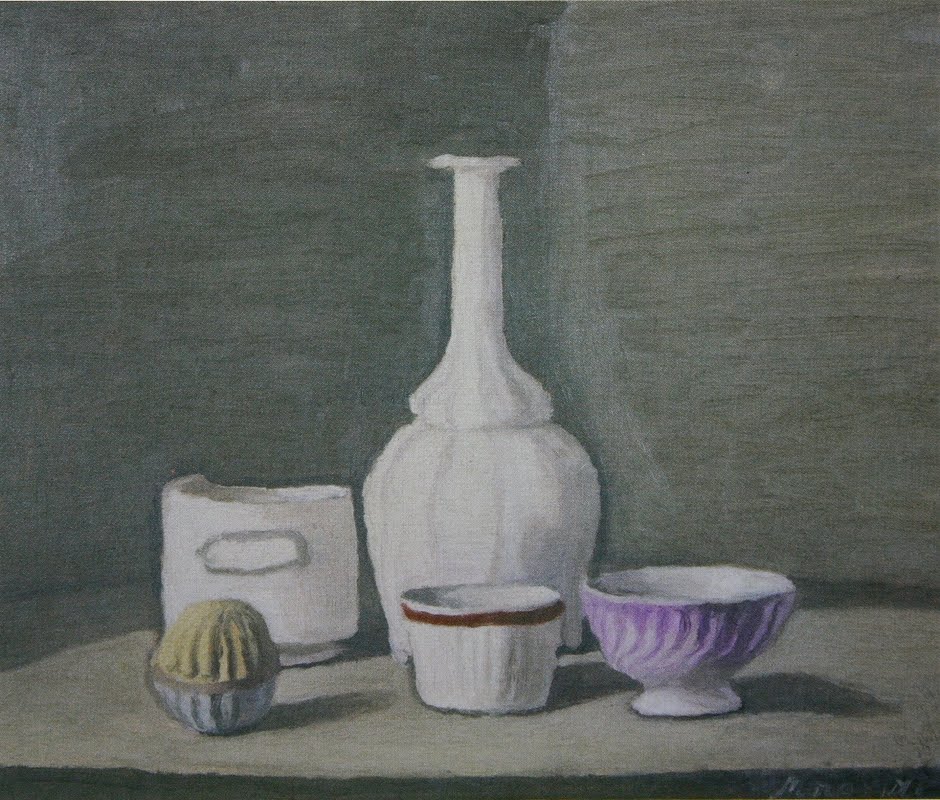
 Still Life, 1946
Giorgio Morandi

Ah...Morandi. This was at the Tate in St. Ives. I always love seeing Morandi; he's always painting more than just bottles. Every brushstroke quivers with life, and his palette and sense of light have a quality that seems to have been frozen in time.  The surfaces of his paintings feel as if they've been laid out on the beach in the sun and sand for like a hundred years; almost like what happens to a piece of glass when it's thrown into the ocean. The retrospective of his work at the Metropolitan Museum in New York a few years ago made a big impression on me.

I love that feeling I get after looking at great paintings like this...totally recharged and ready to get back to work. My goal when I get back to the studio, is to finish off the paintings I started this summer and dive into some new work that I have swimming around in my head. (and check out some upcoming shows in NYC)


Saturday, September 4, 2010

Sketchbook from England

I just got back from a two week trip to England, where my brother-in-law and his family live. We spent one week with them, outside of London, and one week in Cornwall, on a working farm. Here are some images I made in my sketchbook from our time in Cornwall:


This one's a watercolor, which is a medium I use from time to time. I have mixed feelings about working in watercolor. I find it very intriguing, and like the look and feel of it, but it's hard as hell and almost the anti-thesis of oil paint. The working methods are completely different, forcing you to employ the white of the paper as your light, and is obviously transparent and fluid, versus the opacity and density of oil paint. The thing I like about it, is how marks can be made 'unguided', that is, by letting the paint bleed into the wetness of the paper. There is a certain loss of control to this that can yield some great results. I love looking at the great watercolors of Turner, Sargent, and Homer, which have a Zen-like immediacy to them.


This one was done overlooking a pasture at dusk. The clouds were blocking the sun from time to time, giving me a small window of time to look at the scene without being totally blinded by the setting sun. The cattle were wandering to and fro, dotting the vast expanses of green fields with their presence. Looking at these now, I realize how much I need to hold on to that sense of immediacy with the paint. At times, my oil paintings can 'tighten up': I need to retain that freshness and 'roving eye' that these sketches and pencil drawings have.


Here's a couple of pencil drawings depicting the view in back of our cottage. (Sorry about the quality of the photos, the drawings are quite light and hard to photograph.)


This last drawing was done at Whitesand beach, along the southern coast of Cornwall. There's some amazing rock formations along this stretch, with dramatic cliffs, caves, and tide pools. It reminded me of the Maine coast, as well as, Big Sur in California and the Oregon coast. It's the kind of place I could paint for the rest of my life and never get bored. Cornwall has some stunning landscapes, and I can see why artists have flocked there over the years. When I went to St. Ives, I visited the Tate, which has a wonderful location overlooking the beach. I saw some great work there, and enjoyed learning about the history of the area. It was a real haven for nature-based abstraction during the post war era, and I got to familiarize myself with the artists who lived and worked there. In my next post, I'm going to focus on some of the treasures I found at the National Gallery in London....cheers!

For more photos and commentary, check out my wife's blog entries about England!